Google is changing the way some AI Overviews appear in Search. Instead of making users click “Show more” to read the full AI-generated response, Google is now automatically expanding certain AI Overviews when its systems think a longer answer will be helpful.
Table of Contents
It might seem like a minor change to the Search interface. But for SEO professionals and website owners, it brings up a much bigger question:
What happens to organic clicks when Google’s AI answer takes up more space on the search results page?
What Are Google AI Overviews?
AI Overviews are AI-generated summaries that Google displays at the top of some Search results. Their purpose is to give users a quick, useful answer by pulling together information from different sources. Users can then explore the topic further through website links, follow-up questions, or other Search features.
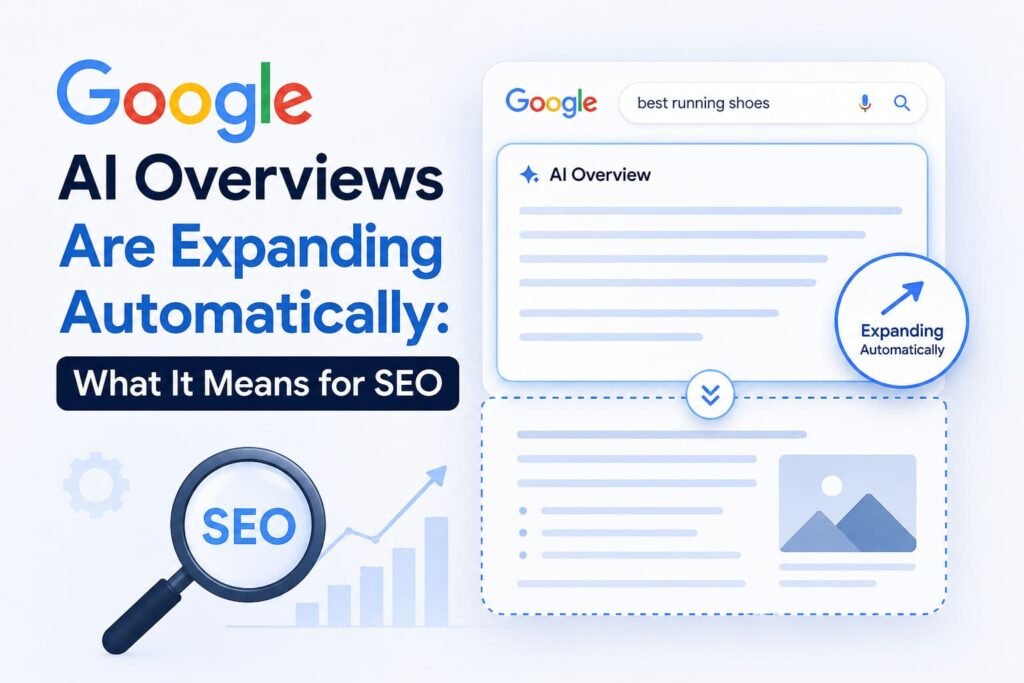
What’s changing is how much space these AI responses can take up. Google is now testing situations where an AI Overview expands automatically instead of waiting for the user to click “Show more.”
What Is New Google AI Overview Behaviour?
Previously, some Google AI Overviews appeared in a shorter format. If users wanted to see more information, they had to click “Show more.” Google is now dynamically expanding some of these responses. If its systems decide that a more detailed answer would be useful, the Google AI Overview can expand on its own. This can include the full response along with the “Ask anything” option.
Google has also indicated that the expansion can stop once the user begins scrolling. The practical effect is pretty straightforward: Users could see much more AI-generated information before they reach traditional organic search results.
Why Does This Matter for SEO?
For a long time, SEO has revolved around one main goal: Get your website to rank as high as possible in Google’s organic results. AI Overviews make that goal a little more complicated. Your page can still rank well, but if a large AI-generated answer appears above it, your result may receive less attention — or potentially fewer clicks.
That doesn’t mean organic traffic will automatically decline for every website. It does mean that ranking position alone is no longer the complete picture. SEO professionals now need to ask another question:
“Is my website visible within Google’s AI-powered search experience?”
Could Google AI Overviews Reduce Organic Clicks?
Potentially, yes. When Google provides more information directly on the results page, users may have less reason to click through to a website. For example, someone searching for a simple informational answer might find everything they need in the Google AI Overview and leave without visiting another site. But that won’t happen with every search.
In some cases, an Google AI Overview may actually encourage users to explore the websites it references. The impact will largely depend on what the person is searching for and what they want to accomplish. Informational searches could be more affected because users can often get a straightforward answer without leaving Google.
Commercial searches may work differently. When someone is comparing products, services, prices, providers, or businesses, they may still need to visit several websites before making a decision.
What Does This Mean for Website Owners?
Website owners need to look beyond rankings. A useful SEO dashboard should track several metrics together:
Impressions
Are your pages still appearing for the searches that matter to your business?
Clicks
Are people actually visiting your website from Search?
CTR
Is the percentage of people clicking your result changing?
Search intent
Are informational searches performing differently from commercial or transactional searches?
Branded vs. non-branded traffic
Are people still discovering your business through generic searches, or are most visitors already searching for your brand?
Looking at all of these metrics together gives you a much clearer picture of what’s happening than simply checking your keyword positions.
Does Traditional SEO Still Matter?
Absolutely. Google AI Overviews haven’t made traditional SEO irrelevant.
Google still relies on its Search systems to understand, evaluate, and rank web content. Technical SEO, useful content, internal linking, relevance, authority, and search intent continue to matter. What’s changing is how Google presents information before users reach individual websites. That’s why traditional SEO and optimisation for AI-driven search increasingly need to work together.
How Can You Improve Your Visibility?
There isn’t a magic “Google AI Overview optimisation” trick that guarantees your website will appear in Google’s AI answers.
But the fundamentals of good SEO are becoming even more important.
Need Help Adapting Your SEO Strategy?
Google Search is changing, and keeping up can be difficult when you’re also trying to run a business.
If you’re unsure whether your current SEO strategy is ready for Google AI Overviews, AI-driven search, and changing user behaviour, it may be worth taking a closer look at your overall digital marketing strategy.
At Hubster Marketing, we help businesses improve online visibility through SEO, content marketing, social media marketing, paid advertising, and other digital marketing services aligned with their business goals.
Whether you want to increase organic traffic, generate more qualified leads, improve your Google visibility, or build a stronger online presence, a well-planned digital marketing strategy can help you adapt as Search continues to evolve.
Want to improve your online visibility? Get in touch with us to discuss a digital marketing strategy for your business.
Create Content That Actually Helps People
Start with the reader, not the keyword. Your content should answer the question clearly, accurately, and without unnecessary filler.
Pages created mainly to target a keyword — without providing much real value — are unlikely to perform well in a search environment where Google is becoming better at understanding content.
Cover the Topic Properly
Don’t stop after answering one narrow question. Think about the other questions someone might naturally have after reading your answer. Creating genuinely useful, comprehensive content can help your website become relevant for a wider range of related searches.
Keep Your Content Well Structured
Clear headings, short paragraphs, bullet points, tables, examples, and logical sections make content easier for people to read. They also make it easier for search engines to understand what your page is about.
Back Up Important Claims
When you’re making important claims, use reliable sources and supporting evidence where appropriate. This is especially important when writing about topics where accuracy and trust matter.
Build Topical Authority
One article usually isn’t enough to establish authority around a competitive subject. Instead, create a network of useful, related content that covers different aspects of the topic. Over time, this can help demonstrate that your website has genuine depth and expertise in that area.
What Should You Avoid to Rank for Google AI Overviews?
It’s easy to overreact whenever Google announces a Search update. But making major changes without looking at your actual data can create more problems than it solves. You don’t need to remove useful content simply because Google AI Overviews are appearing. You don’t need to fill your articles with extra keywords.
And you certainly don’t need to rewrite every heading just because Google has changed the way its Search results look. A better approach is to watch your data, understand what’s changing, and make decisions based on actual performance.
Google AI Overviews Are Part of a Much Bigger Change
The automatic expansion of Google AI Overviews is just one part of the bigger changes happening in Google Search. Google is also expanding the capabilities of AI Mode, including features designed to help users research topics and complete commercial tasks. This points to a broader change in how people use search engines. Search is gradually moving from simply showing users websites to helping them complete a task or find an answer.
For marketers, that means SEO may eventually become less about winning one particular ranking position and more about becoming a trusted source throughout the entire search journey.
The New SEO Question for Google AI Overviews
The traditional SEO question has always been: “How do I rank number one?” Increasingly, there’s another question worth asking: “How do I become a source Google trusts when it generates an answer?”
That’s a significant shift. Your website needs to provide enough value that it can earn visibility, references, and clicks even when Google is handling more of the information processing itself.
Final Thoughts
Google’s decision to automatically expand some AI Overviews is another indication that the Search experience is changing quickly. For website owners, though, this doesn’t mean it’s time to abandon traditional SEO. It means the strategy needs to become broader.
Keep tracking rankings, clicks, impressions, and CTR. But also pay attention to how your content is being surfaced and represented in AI-powered search experiences. Most importantly, keep doing the fundamentals well: Create content that is useful, trustworthy, well-structured, and genuinely better than what’s already available. Those qualities remain some of the strongest foundations for succeeding in both traditional Google Search and the increasingly AI-powered search experience.
If you’re finding it difficult to keep up with Google’s changing Search landscape, you don’t have to figure it all out on your own. The right combination of SEO, content, paid marketing, and other digital strategies can help your business stay visible and continue attracting the right audience.
Looking to grow your business online? Explore our digital marketing services tailored specifically for Google AI overviews and let’s build a strategy that works for your goals.