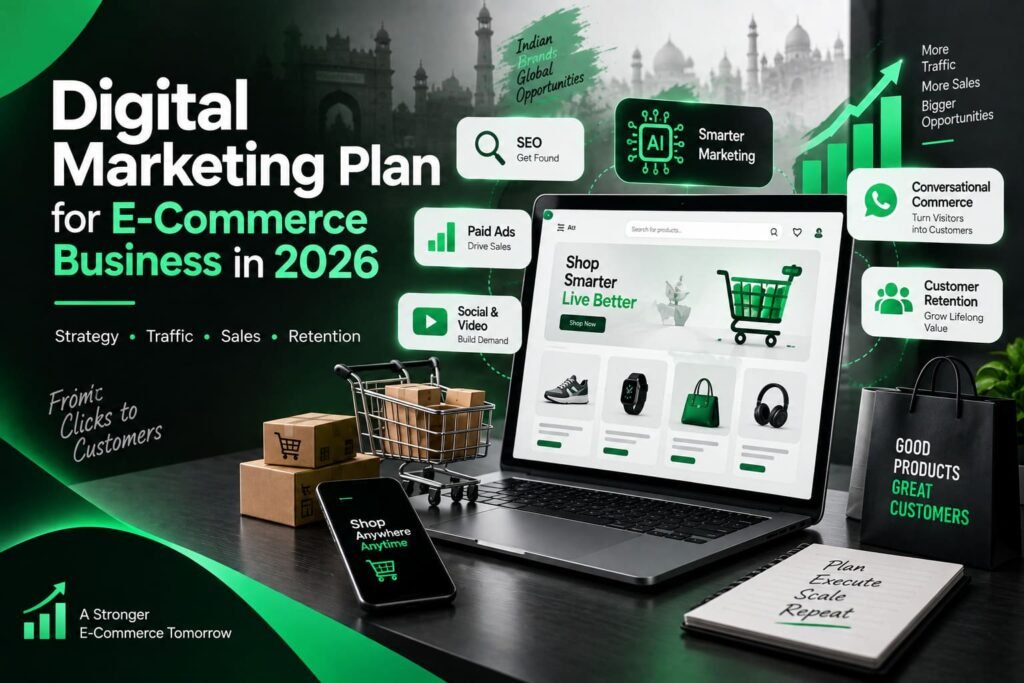
Running an E-Commerce business in 2026 is very different from simply putting products online and running a few ads. Customers now discover products through Google, social media, marketplaces, creators, AI-powered search experiences, videos and recommendations. At the same time, advertising costs can increase quickly when brands compete for the same audience. That is why an effective Digital Marketing Plan for E-Commerce Business in 2026 needs to connect the entire customer journey—from the first product discovery to the purchase and the second order.
Quick Answer
A Digital Marketing Plan for Ecommerce Business in 2026 should combine SEO, Google Ads, Meta Ads, social media, content marketing, creator marketing, conversion optimization and customer retention. Start by understanding your target customers, optimize product pages and tracking, then use paid and organic channels to bring qualified traffic. Finally, focus on retargeting, email/WhatsApp marketing, repeat purchases and data-driven optimization to turn more visitors into customers and improve long-term revenue.
Want to increase your ecommerce traffic, sales and online visibility? Hubster Marketing helps ecommerce businesses with SEO, Google Ads, Meta Ads, social media, content marketing and conversion-focused digital marketing strategies.
Table of Contents
This guide explains how to build that strategy step by step.
What Should an Digital Marketing Plan for E-Commerce Include?
A strong ecommerce marketing strategy should cover six major areas:
- SEO and organic search
- Google and paid advertising
- Social media marketing
- Content and video marketing
- Conversion rate optimization
- Customer retention and remarketing
The goal isn’t to spend money on every channel. The goal is to understand where your customers discover products, what makes them trust your brand, and what finally makes them buy.
1. Start With Your Digital Marketing Plan for E-commerce with Goals:
Before choosing platforms, decide what you actually want to achieve.
Your goals could include:
- Increasing online sales
- Reducing customer acquisition cost
- Increasing average order value
- Getting more repeat customers
- Building brand awareness
- Entering a new city or market
- Increasing organic traffic
- Improving conversion rates
Don’t use only “increase sales” as your goal. For example:
Goal: Generate ₹20 lakh in monthly online revenue.
Then work backward:
Revenue → Orders → Conversion Rate → Website Traffic → Marketing Channels
If your average order value is ₹2,000, ₹20 lakh in revenue requires approximately 1,000 orders. If your website converts at 2%, you would need around 50,000 qualified sessions to generate those orders. This simple calculation helps you understand how much traffic and marketing investment your business actually needs.
2. Understand Your Customers Before Spending
One of the biggest mistakes E-commerce businesses make is targeting “everyone.” Instead, divide your customers into meaningful groups. For example:
New Customers
People who have never purchased from your brand.
Your focus should be:
- Awareness
- Product education
- Trust
- Reviews
- First-purchase offers
Interested Customers
People who visited your website or interacted with your content but haven’t purchased.
Your focus should be:
- Retargeting
- Product benefits
- Social proof
- FAQs
- Comparison content
Existing Customers
People who have already purchased.
Your focus should be:
- Repeat purchases
- Cross-selling
- Upselling
- Loyalty
- Personalized offers
This segmentation allows you to spend different amounts of money on different stages of the customer journey.
3. Build an SEO Strategy Around Products and Problems
SEO remains an important part of Digital marketing plan for E-commerce, but product pages alone aren’t enough. Your SEO strategy should cover three types of search intent.
Product Keywords
Examples:
- Buy running shoes online
- Wireless earbuds under ₹2,000
- Organic skincare products
- Men’s formal shirts online
These keywords have strong commercial intent.
Category Keywords
Examples:
- Best running shoes
- Men’s skincare products
- Office bags for women
- Home gym equipment
These can help category pages attract customers who are still comparing products.
Problem-Based Keywords
These are often overlooked.
Examples:
- How to choose running shoes
- How to clean leather shoes
- Best skincare routine for oily skin
- How to choose the right office chair
Create useful content around these questions and connect the reader naturally to relevant products.
4. Optimize Your Product Pages
Driving traffic to a poor product page is one of the easiest ways to waste a marketing budget. Every important product page should clearly communicate:
- Product name
- High-quality images
- Product benefits
- Key specifications
- Price
- Discounts, if applicable
- Availability
- Delivery information
- Return policy
- Reviews
- FAQs
- Clear call-to-action
Don’t write product descriptions only for search engines. Write them for a customer who is asking: “Why should I buy this product instead of another one?” That is the question your product page needs to answer.
5. Use Google Ads to Capture Purchase Intent
Google Ads can be particularly valuable for Digital Marketing Plan for E-commerce businesses because customers are often searching with clear buying intent.
Your campaign structure can include:
Search Campaigns
Target high-intent searches related to your products and categories.
Shopping Campaigns
Use product feeds to showcase products directly in Google’s shopping ecosystem.
Performance Max
Use Google’s automation across eligible inventory while maintaining strong product data, conversion tracking and creative assets.
Brand Campaigns
Protect your brand searches when appropriate and make it easier for existing customers to find your store.
Remarketing
Reconnect with visitors who viewed products or added products to their cart but didn’t purchase. The important part is not simply launching campaigns. Your product feed, tracking, landing pages and conversion data need to be accurate.
6. Make Meta Ads Part of the Discovery Strategy
Google often captures existing demand. Meta platforms can help create that demand. Instagram and Facebook are particularly useful for products that benefit from visual presentation.
Use formats such as:
- Reels
- Stories
- Carousel ads
- Product demonstrations
- Customer testimonials
- Before-and-after content
- Creator content
- UGC-style videos
Don’t make every ad look like a traditional advertisement. A simple creator video showing how the product is used can sometimes communicate more effectively than a heavily designed promotional graphic.
7. Build a Real Social Media Content Strategy
Posting randomly every day is not a social media strategy. Create content around different customer questions. A practical Digital Marketing Plan for E-commerce content mix could include:
Educational Content
Teach people something related to your product.
Product Content
Show features, benefits and use cases.
Social Proof
Share customer reviews, testimonials and user-generated content.
Behind the Scenes
Show manufacturing, packaging, people and your brand story.
Entertainment
Create relatable or trend-based content that fits your audience.
Promotional Content
Use offers, launches, sales and seasonal campaigns. The objective is to make your social channels useful even when the customer isn’t ready to buy immediately.
8. Use Influencer and Creator Marketing
Influencer marketing in 2026 is no longer limited to celebrities. For many E-commerce businesses, micro and mid-tier creators can be more relevant because they have focused audiences.
Instead of asking a creator to simply say:
“Buy this product.”
Give them a reason to demonstrate it.
For example:
- Product tutorial
- Unboxing
- Styling video
- Product comparison
- Day-in-the-life integration
- Problem-and-solution video
- Honest product experience
You can then reuse successful creator content in your paid advertising. This creates a useful connection between creator marketing and performance marketing.
9. Create Content That Helps Customers Buy
E-commerce content shouldn’t exist just to increase page views. Its job should be to help customers make decisions.
Useful formats include:
- Buying guides
- Product comparisons
- “Best products for…” articles
- How-to guides
- Product explainers
- FAQs
- Videos
- Customer stories
For example, instead of publishing: “10 Benefits of Our Product” create: “How to Choose the Right Product for Your Needs: A Complete Guide” The second topic answers a real customer problem and naturally creates opportunities to introduce your products.
10. Optimize Your Website for Conversions
More traffic doesn’t automatically mean more revenue. If 100,000 people visit your website but only 1% purchase, you have a conversion problem.
Review your website for:
- Mobile experience
- Page speed
- Product navigation
- Search functionality
- Checkout process
- Payment options
- Trust signals
- Product reviews
- Return information
- Shipping information
Reduce unnecessary steps between product discovery and payment. A customer shouldn’t have to search through multiple pages to understand delivery charges or return conditions.
11. Make Mobile Experience a Priority
A large part of ecommerce discovery and shopping happens on smartphones. Your mobile website should make it easy to:
- Search products
- Filter categories
- View images
- Read reviews
- Add products to cart
- Apply coupons
- Complete payment
Don’t simply check whether your website “works” on mobile. Actually test the buying journey like a customer. Open the website on your phone, search for a product, add it to the cart and complete the checkout process. You may discover problems that analytics alone doesn’t reveal.
12. Build a Strong Retargeting System
Not every visitor will purchase during their first visit. That’s normal. Your retargeting strategy can target different customer actions.
Viewed Product
Show the product again with useful information or social proof.
Added to Cart
Remind the customer about the product and remove potential purchase objections.
Started Checkout
Focus on reducing friction and helping complete the purchase.
Existing Customer
Promote complementary products or relevant new launches. Don’t show the same advertisement to everyone. Retargeting works better when the message reflects what the customer actually did.
13. Use Email and WhatsApp for Retention
Acquiring a customer is usually only the beginning. Build a system for communicating with existing customers. You can use email or appropriate messaging channels for:
- Order updates
- Product recommendations
- New launches
- Restock alerts
- Educational content
- Personalized offers
- Abandoned-cart reminders
- Repeat-purchase reminders
For example, if a customer purchases a product that normally needs replacement after several months, a timely reminder can create another sale without requiring the same acquisition cost as a completely new customer.
14. Increase Average Order Value
You don’t always need more customers to increase revenue. You can also increase the value of each order.
Try:
Cross-Selling
“Customers who bought this also purchased…”
Upselling
Offer a better version or larger pack.
Product Bundles
Combine related products at an attractive price.
Quantity Offers
For example:
Buy 2 and save 10%.
Free Shipping Thresholds
Set a minimum order value that encourages customers to add another product. These strategies can improve revenue without depending entirely on additional traffic.
15. Use Reviews as a Marketing Asset
Reviews aren’t just for product pages. Use genuine customer feedback throughout your marketing.
You can turn reviews into:
- Social media posts
- Video scripts
- Ad creatives
- Website sections
- Email campaigns
- Product FAQs
A customer explaining why they bought your product and what problem it solved can be more persuasive than a generic marketing statement. Never manufacture or buy fake reviews.
16. Prepare for AI-Driven Search and Discovery
Ecommerce search is becoming more conversational. Customers may increasingly ask AI systems questions such as:
“What’s a good laptop for a college student under ₹60,000?”
or:
“Which skincare products are suitable for sensitive skin?”
Your brand should therefore have clear, useful information available online.
Focus on:
- Detailed product information
- Clear specifications
- Helpful FAQs
- Comparison content
- Customer reviews
- Expert or brand information
- Consistent product data
Don’t create content only because you think an AI system might mention your website. Create information that genuinely helps customers understand your products.
17. Use Analytics to Control Your Budget
Your Digital Marketing Plan for E-commerce dashboard should go beyond clicks and impressions.
Track:
- Revenue
- ROAS
- CAC
- Conversion rate
- Average order value
- Repeat purchase rate
- Customer lifetime value
- Organic traffic
- Paid traffic
- Cart abandonment
- Channel-level revenue
Then compare channels based on their role. For example, SEO may bring customers slowly but continue generating traffic without paying for every click. Paid advertising may produce faster results but requires continuous investment. Email and retention campaigns may generate revenue from customers you’ve already acquired. Each channel should therefore be judged according to its role in the overall business.
18. Create a Monthly Ecommerce Marketing Calendar
A practical 2026 Digital Marketing plan for E-commerce should be broken into monthly activities.
Month 1: Foundation
- Technical SEO audit
- Analytics setup
- Conversion tracking
- Product feed cleanup
- Website UX review
- Customer research
Month 2: Organic Growth
- Keyword research
- Category optimization
- Product page optimization
- Content planning
- Internal linking
Month 3: Paid Acquisition
- Google Ads
- Shopping/Performance Max
- Meta campaigns
- Retargeting
- Creative testing
Month 4: Content & Creator Growth
- UGC campaigns
- Influencer partnerships
- Video content
- Product demonstrations
- Customer testimonials
Month 5: Conversion Optimization
- Landing-page testing
- Checkout improvements
- Offer testing
- Bundle testing
- A/B testing
Month 6 and Beyond: Scale
- Increase investment in profitable campaigns
- Expand successful products
- Build retention campaigns
- Test new audiences
- Enter new markets
- Improve customer lifetime value
The exact timeline can change depending on your business size and sales cycle.
19. How Much Should an Ecommerce Business Spend?
There is no universal digital marketing budget for every ecommerce company. A better approach is to work backward from your revenue target.
For example:
Target Revenue → Required Orders → Required Traffic → Conversion Rate → Marketing Investment
Then divide the budget across channels based on your historical performance. A new E-commerce brand may need to invest more heavily in awareness and customer acquisition. An established brand with strong organic traffic and repeat customers may put more emphasis on retention and conversion optimization. The important thing is to measure before scaling.
20. A Simple Ecommerce Marketing Funnel
Your complete strategy can be viewed as four stages:
Awareness
SEO + Social Media + Creators + Video Content
↓
Consideration
Product Pages + Reviews + Comparison Content + Retargeting
↓
Conversion
Google Ads + Meta Ads + Offers + CRO + Easy Checkout
↓
Retention
Email + WhatsApp + Loyalty + Cross-Selling + Repeat Purchases
This is much more effective than treating every marketing channel as a separate activity.
Common Digital Marketing Plan for E-commerce Mistakes to Avoid
Even with a large budget, Digital Marketing Plan for E-commerce marketing can struggle because of basic mistakes.
Avoid:
- Running ads without proper conversion tracking
- Sending paid traffic to weak product pages
- Ignoring mobile users
- Copying competitors’ content
- Targeting everyone
- Depending entirely on discounts
- Ignoring existing customers
- Buying low-quality backlinks
- Publishing content without search intent
- Scaling campaigns before understanding profitability
- Measuring success only through clicks
The biggest mistake is usually scaling before the fundamentals are working.
Need Help With Your Digital Marketing Plan for E-commerce?
Building an ecommerce marketing system requires more than running advertisements. Your SEO, Google Ads, Meta Ads, content, social media, website and retention strategy need to work together.
Hubster Marketing helps businesses build complete digital marketing strategies designed to improve online visibility, attract qualified customers and generate sustainable growth.
Build a stronger Digital Marketing Plan for E-commerce for 2026. Contact Hubster Marketing today.
Final Thoughts
A successful Digital Marketing Plan for E-commerce Business in 2026 should not be built around one platform. Google can capture existing demand. Social media can create discovery. Creators can build trust. SEO can generate long-term visibility. Paid advertising can accelerate acquisition. Email and retention marketing can bring customers back.
The real advantage comes from connecting all of these channels. Start with your customer, understand the numbers, fix your website, test your marketing and then scale what actually works. Don’t try to be everywhere. Build a marketing system that moves customers from discovery to purchase—and from their first purchase to the next one.
FAQs
What is the best digital marketing Plan for E-commerce business in 2026?
A strong strategy combines SEO, Google Ads, Meta Ads, social media, content, creator marketing, conversion optimization and customer retention. The right mix depends on the business, product and audience.
How can ecommerce businesses increase online sales?
Businesses can increase sales by improving product pages, targeting high-intent customers, running well-tracked paid campaigns, creating useful content, using retargeting and improving the checkout experience.
Is SEO still important for ecommerce in 2026?
Yes. SEO can help ecommerce businesses attract customers searching for products, categories, solutions and buying information. Product and category optimization should be combined with useful informational content.
Should ecommerce businesses invest in influencer marketing?
Creator marketing can be useful when the creator’s audience matches the product’s target customer. Brands should focus on relevant creators and measurable outcomes rather than follower count alone.
How important is retargeting for ecommerce?
Retargeting can help reconnect with visitors who showed purchase intent but didn’t complete an order. Messages should be adapted to actions such as product views, cart additions and previous purchases.
How much should an ecommerce business spend on digital marketing?
There is no fixed amount that works for every ecommerce business. Budget should be based on revenue goals, margins, customer acquisition cost, conversion rate, average order value and available cash flow.